
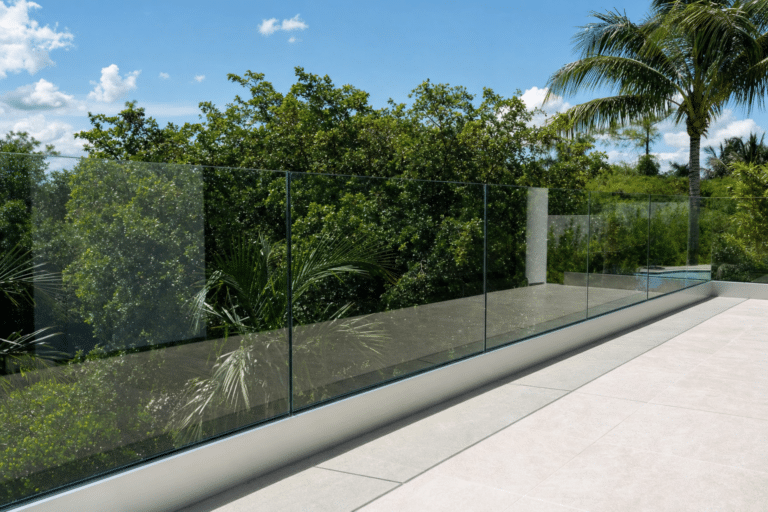
You want that clean, modern look of glass railings on your Miami deck, balcony, or staircase. But you're worried about hurricane safety, salt air eating your hardware, and Miami-Dade County's strict building codes. Get the materials or the installation wrong and you're looking at failed inspections, expensive permit violations, and railings that won't make it through the next big storm. We specialize in hurricane-resistant glass railing installation across Miami-Dade and Broward counties, and we handle the whole thing: engineered drawings, permit applications, code-compliant installation, and final inspections. Call us at (786) 558-7575 for a free consultation, or schedule your on-site assessment today.
Installing glass railings in Miami is nothing like doing it anywhere else in the country. You're up against hurricane-force winds that top 150 mph, constant salt spray that corrodes standard hardware within months, and building codes written specifically for the High Velocity Hurricane Zone (HVHZ). Plenty of homeowners in Miami Beach, Brickell, and Coral Gables want those unobstructed waterfront views with sleek glass railings. Then they hesitate. Can glass really hold up to our coastal conditions?
Pick the wrong system or the wrong installer and the fallout is real. Non-compliant installations fail inspection, which means expensive tear-outs and doing the job twice. Glass without proper impact resistance can shatter in a storm and turn into flying debris. And hardware that isn't rated for the coast corrodes fast, which puts the whole structure at risk.
We take those worries off the table with professional glass railing installation built for Miami's conditions. Every install we do uses Miami-Dade Notice of Acceptance (NOA) approved systems engineered to meet HVHZ wind load requirements. We manage the full permitting process, prepare engineered drawings, coordinate building department inspections, and install with corrosion-resistant hardware rated for coastal exposure.
Don't try to handle Miami's building codes on your own. Call us at (786) 558-7575 for a free consultation with our glass railing specialists, or schedule your on-site assessment online. We'll walk your property, explain your options, give you a detailed quote, and take care of every part of permitting and installation.
Miami glass railing installation demands hurricane-resistant materials, salt-air resistant hardware, and Miami-Dade County code compliance that goes well past standard Florida Building Code. The High Velocity Hurricane Zone (HVHZ) covers all of Miami-Dade County and parts of Broward County. It requires every building component, glass railings included, to withstand winds of 150 mph or more and resist impact from wind-borne debris (source).
Standard tempered glass railings that work just fine in Orlando or Tampa won't cut it here. Miami requires impact-resistant laminated glass with specific thickness requirements and engineering calculations that prove wind load resistance.
Miami-Dade County enforces building code requirements that go beyond the minimum Florida Building Code. Residential glass railings have to reach a minimum height of 42 inches for decks and balconies, 36 inches for interior stairs, with spacing tight enough that a 4-inch sphere can't pass through anywhere. The glass has to be tempered or laminated at a minimum thickness of 1/2 inch, though for exposed coastal properties we usually recommend 5/8-inch or 3/4-inch laminated glass (source).
Every glass railing system needs engineered drawings stamped by a Florida-licensed engineer, proving the design meets or beats wind load requirements for your exact location. Properties sitting right on Biscayne Bay or the Atlantic face higher wind load calculations than inland ones.
HVHZ compliance means every part of your glass railing system carries Miami-Dade Notice of Acceptance (NOA) approval: the glass panels, the mounting posts, the base plates, the fasteners, and the handrails. That certification confirms the product has been through rigorous testing for wind resistance and impact performance built around Miami's hurricane risk.
Our coastal climate throws challenges at you beyond the wind. Salt spray off the Atlantic and Biscayne Bay creates a corrosive environment that chews through standard stainless steel hardware. That's why we spec marine-grade 316 stainless steel fasteners and components on all coastal installations, with extra corrosion-resistant coatings for properties sitting in direct salt spray zones.

Yes. Glass railing installations in Miami require a building permit from Miami-Dade County or your local municipality. That covers nearly every railing project: deck railings, balcony railings, staircase railings, and pool barriers. Even swapping out existing railings needs a permit, because the new install has to meet current code.
The permit requirement is what makes sure your glass railings are properly engineered to survive a hurricane. Unpermitted construction raises the risk of structural failure during extreme weather, and insurance companies can deny storm damage claims on improvements that were never permitted.
The permit process starts with submitting engineered drawings and product specifications to the Miami-Dade Building Department or your local municipality. A Florida-licensed professional engineer has to prepare and stamp those drawings, showing the install meets wind load requirements, height and spacing codes, and HVHZ standards.
We handle the whole application for our clients. We prepare all the required documentation and coordinate with our network of structural engineers who know Miami-Dade code inside and out. A typical permit review runs 2 to 3 weeks, though complex projects can take a little longer.
Permit applications require Miami-Dade NOA documentation for every railing component, product spec sheets, manufacturer installation instructions, and site plans showing where the railing goes. We keep current NOA documentation on hand for all the glass railing systems we install and include those certifications in your permit package.
Once your permit is approved and the install is done, Miami-Dade County requires a final building inspection before the permit can close. The inspector confirms the work matches the approved drawings, checks fastener spacing and anchoring, verifies glass thickness and type, and measures height and spacing for compliance.
The right glass railing system for your Miami property comes down to your look, your budget, and how exposed your specific location is to wind and salt spray. We walk clients through the choice, weighing the clean modern feel of frameless systems against the added durability of framed options, and every recommendation we make meets Miami-Dade code.
Your property's conditions carry a lot of weight here. Oceanfront homes in Miami Beach or Key Biscayne take the worst of the salt spray and wind loads, so they often call for tougher systems with extra corrosion protection.
Frameless glass railing systems give you the most open, unobstructed views, using thick glass panels mounted right to the deck or balcony surface with barely any visible hardware. They create that sleek, contemporary look that's so popular in Brickell condos and modern waterfront homes. The panels usually run from 5/8-inch to 3/4-inch thick laminated tempered glass, strong enough to meet wind load requirements without vertical posts breaking up the view.
Here in Miami, frameless systems need careful engineering and NOA-approved base shoe or spigot mounting. The base channels have to be sealed tight against water intrusion and built from marine-grade materials to fight off corrosion.
Frameless usually sits at the higher end on cost, thanks to the thicker glass and the precision the install takes. But a lot of clients decide the open views and modern look are worth it, especially on a property where the ocean or bay view is the whole selling point.
Framed glass railing systems use vertical posts with glass panels set between them, often with top and bottom rails that complete the frame. You get more structural stability, and sometimes you can use slightly thinner glass because the frame carries extra support. Framed setups also open up more design choices: different post styles, rail profiles, and finish colors.
For coastal Miami work, we spec framed systems with marine-grade aluminum or 316 stainless steel posts and rails that stand up to salt spray. Powder-coated aluminum framing does especially well by the coast, holding its look and its strength with very little maintenance.
Framed systems often deliver better value on bigger projects, or where maximum view transparency isn't the main goal. They can also help when the mounting surface has limits, since the post structure sometimes spreads loads more effectively than a continuous base channel.
Miami glass railing installations require either tempered or laminated glass, and we strongly recommend laminated tempered glass for HVHZ compliance. Laminated glass is two layers of tempered glass bonded with a polymer interlayer. Take a hard hit and it may crack, but the interlayer holds it together, so it keeps working as a barrier even when it's damaged.
Minimum thickness is 1/2 inch, but for most Miami work we install 5/8-inch or 3/4-inch laminated glass. That extra thickness gives you better wind load resistance, less flex during storms, and a more solid feel underhand. On frameless systems or seriously exposed spots, the engineering calculations may call for 3/4-inch.
Yes. Properly engineered and installed with impact-resistant glass and hurricane-rated hardware, glass railings can stand up to Miami's hurricane-force winds. Systems with Miami-Dade NOA approval have made it through multiple major hurricanes in South Florida, including direct hits from Category 4 storms.
The engineering behind these railings tackles both wind pressure and impact. Wind load calculations set the required glass thickness, mounting spacing, and anchoring strength needed to resist sustained winds of 150+ mph, plus gusts that can top 180 mph.
Impact-resistant glass for Miami railings has to pass Miami-Dade County's large missile impact test. That test fires a 9-pound 2×4 lumber projectile at the glass at 50 feet per second, then runs 9,000 cycles of positive and negative pressure equal to hurricane wind loads (source). Laminated tempered glass that passes earns NOA approval for HVHZ use.
The laminated construction is what makes the difference. Tempered glass is strong, sure, but it shatters completely once an impact beats its strength threshold. Laminated glass may crack on impact, and the polymer interlayer holds every fragment in place, keeping the barrier intact and stopping loose glass from becoming a projectile of its own.
See Why Tampa Homeowners Choose Glass Experts for Glass Railing Installation
"*" indicates required fields